Orange is the new surveillance
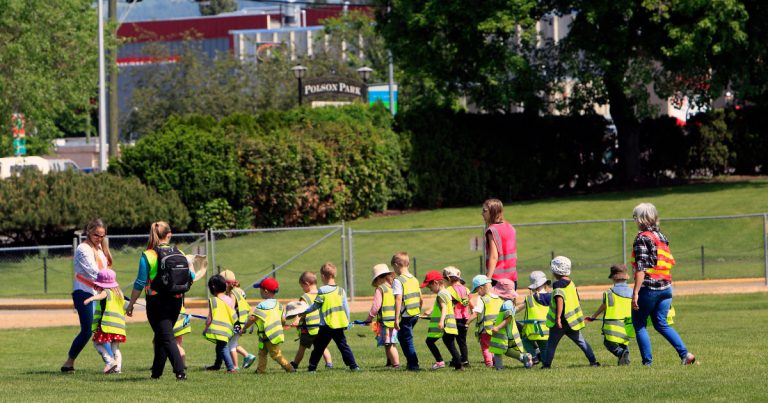
‘Putting children on a hi-vis alert in the community is depriving them an opportunity to take responsibility for their own safety.’ KAREN HOPE and HELEN JENNINGS, explore what this means and give their perspective on pre-school aged children wearing hi-vis clothing when outside the enclosure of their early childhood setting.
In parks, museums and other public spaces there are groups of preschool-aged children turning orange on excursions. You might have noticed these children, and their educators, as they move about in your community. They would be easy to see as they stroll about wearing hi-vis vests that people employed in hazardous industries wear as personal protective equipment. Hi-vis vests were designed to signal a person’s presence in a potentially risky space, so why are children wearing them in the park?
The rise of young children wearing hi-vis vests on excursions is perplexing. Is it an issue of personal protection, or an issue of ‘perceived’ efficient supervision— where supervising children is so much easier if they look the same and, even better, have the service name emblazoned on the back? Or, worse, is it a case of fashion— where it’s a matter of keeping up with the service down the street?
 Whatever the reason, what are Educators saying when children are required to wear personal protective clothing to the park? Is the interpretation for children that: ‘There are potential risks for you in this situation and being outside with the community requires protective equipment’? What does this tell children about venturing into the community?
Are we suggesting that being outside the confines of a service requires special, different clothes? The message this sends is that simply walking in the streets and parks is not a normal activity. To enjoy it requires planning, preparation and protective clothing. It is no longer a simple pleasure. We are not suggesting that preschool children be free to roam the streets unsupervised. But neither should they be seen as ‘other’ to the norm—these are their streets and parks too. And what of the adults who see children in hi–vis vests. What message does this send to them? Are they thinking children are outsiders because they are outside the ‘norm’? Adults are not expected to dress differently when in a group, why should children?
Early childhood educators are charged with the responsibility to keep children safe. Active and efficient supervision and engagement with children are ways they do this. The National Quality Standard, the National Law and the Early Years Learning Framework all help ensure they acquit this responsibility. Educators want children to be safe, but there is a difference between being safe and safeguarding. The risk versus safety paradox is very much in play here.
In early learning, it is widely believed that children are citizens with rights, potentials and competencies. We too believe this, and that children are experts in their own lives who do, and should, encounter risk in their social, physical and personal lives. The challenge for educators is to provide programs through policy, practice and frameworks that safeguard children, yet which also give them opportunities engage in supported, risk-taking situations. This in turn supports a deeper understanding of risk.
A big feature of modern day childhood and parenting is surveillance. This is achieved through regulations, technology and a focus on risk minimisation. It could be argued that risk and danger are inherent features of childhood. Life is risky. Exposure to an unfamiliar environment supports a child’s autonomy, creativity and the capacity to make decisions. It also supports their capacity to evaluate personal risk. When educators demonstrate a deep respect for children’s skills, intelligence and potential, a trust between them is formed. The inclusion of risk in programs builds on children’s intrinsic motivations to do the right thing. When children are dressed in hi-vis vests they are deprived an opportunity to not only take responsibility for their own safety but to engage in risk.
Society needs to deconstruct what is a pervasive panic about children. Risk should not be managed by dressing children in a manner that results in them being alert and alarmed. The risk around children going on excursions should be managed by an increase in the number of adults supervising children, robust planning pre-excursion, and a reliance on children. Not by dressing them in hi-vis vests.
Co-author
Helen Jennings is a consultant social planner who works with local governments and non-government organisations. She has previously worked in a range of roles including neighbourhood planning, family and children’s services and managing an adventure playground. She is currently tutoring in city planning at Melbourne University. Helen’s interest in the city, place and children’s mobility stems from her studies in Urban Anthropology and observations of how place is used and how groups are included or excluded through subtle design.