School readiness
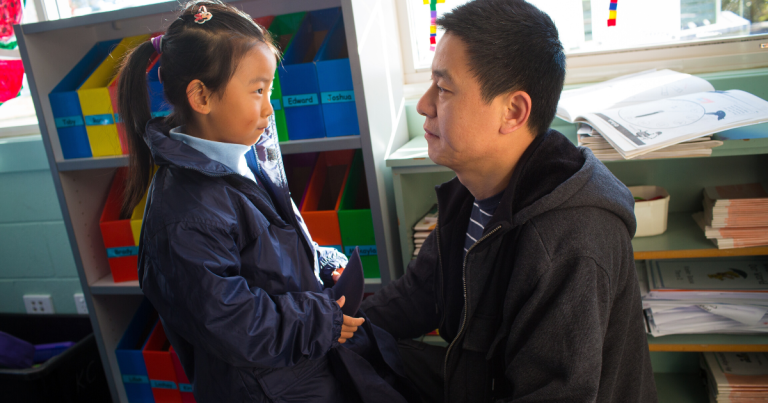
The problem with ‘school readiness.’
‘School readiness’—many find it controversial. MAREE ALDWINCKLE explores this concept and shares her experience as an early childhood teacher and academic. How can we use better terms and activities to describe children preparing for their transition to school? This question has never been more relevant as Australian children slip behind the OECD average in maths and show a decline in science and reading skills.
Judging from the discussions that occur regularly in my preservice early childhood teacher classes, it seems that there is an obsession with school readiness in early childhood services. Every time I hear this term, I squirm inside. I really would like to remove the concept from our early childhood vocabulary.
The term ‘school readiness’ is loaded with subtext and meanings. It suggests to most people—parents, teachers and educators—that children need to be ready for school in some developmental or academic manner. It implies that children need to be ‘made ready’ or ‘be ready’. It suggests that there is some benchmark that children need to meet to be an acceptable ‘big school’ student.
School readiness should be about whether the school is ready or suitable for the child. Not the other way around. Schools should be accountable and ready to meet the diverse needs and abilities of children. All children should be accepted and valued by the school community.
In Australia, we have a free, public school system that is open to all. The NSW Department of Education tells us, ‘Every child is entitled to be enrolled at the government school…that the child is eligible to attend.’ Every child, not just those who are ready! Eligibility is determined by the child’s home location and age. ‘All children must be in compulsory schooling by their 6th birthday’ (NSW Department of Education, 2019).
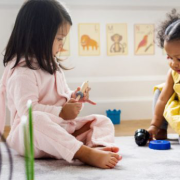
Parents and educators need to recognise that every play experience we provide for infants and young children is part of school preparation, whether this is at home or in an early childhood environment. Every conversation, every book we read, every song we sing, every time we go to the park, every time we cook together—it is these types of shared experiences with adults that are preparing children for school.
Did somebody say ‘books’? There is much research linking the number of books in the home, and adults reading aloud to children, to academic success at school and later occupational achievement (Sikora, Evens & Kelly, 2019). Drilling with stencils, closed-ended pencil and paper tasks, repeating the alphabet and numbers, letter of the week activities, colouring-in, activity sheets and long adult-directed group times are not effective. Many educators believe these types of experiences can be destructive to developing a love of learning in young children.
We all know that starting school is a significant life-changing event for children and their parents. I can still vividly remember being overwhelmed and awed by my first day at kindergarten. The focus should be on preparing children for the change to the more formal school setting and reducing the anxiety associated with this transition.
As a start, educators and parents can work to demystify school through school visits, discussing schools ‘rules’, and talking about the physical trappings of the school environment which can be so different from early childhood environments. Remember group sizes are larger, there are fewer adults per child, morning tea and lunches are packed and eaten outside, and classrooms are arranged differently with an emphasis on table and chair configurations. Integrating ‘all about school’ activities, pretend play, stories and books and providing many opportunities for children to share their questions, concerns and knowledge about going to ‘big school’ are much more valuable than any closed-ended activity sheets.
So, please let’s replace the term ‘school readiness’ with a more meaningful and effective phase such as ‘transition to school’. Shift the focus to minimising anxiety and managing change rather than knowing the alphabet, numbers and colouring-in. Sue Dockett and Bob Perry (2014) have been researching and writing about this for years, but for some reason, the message is not trickling down to many preschool and childcare services in Australia.
References
Dockett, S. & Perry, B. (2014). Continuity of Learning: A resource to support effective transition to school and school age care. Canberra, ACT: Australian Government Department of Education.
NSW Department of Education (2019). Primary school enrolment. Retrieved October 2, 2019, from www.education.nsw.gov.au/public-schools/going-to-a-public-school/enrolment/primary-school-enrolment
Sikora, J., Evans, M. D. R. & Kelley, J. (2019). Scholarly culture: How books in adolescence enhance adult literacy, numeracy and technology skills in 31 societies. Social Science Research, 77, 1-15. Retrieved from www.sciencedirect.com/science/article/pii/S0049089X18300607