Quality and safety in ECEC—what does ROGS really say? Hint: it isn’t what you read in some media reports…

For data nerds in the early childhood sector, ‘ROGS Day’ is a big thing. This year, the Productivity Commission’s Report on Government Services (ROGS) chapter on early childhood education and care (ECEC) was published on 10 February. Many daily newspapers reported on the ROGS chapter on the ECEC sector with a focus on serious incidents being at record highs, along with staffing waivers (
But a deeper examination shows that while the Report finds the sector can and must do better, there’s some good news on improvements being made, particularly on reporting.
Child sexual abuse is not historic, rare or isolated. It is a national problem. One in four Australian children experience sexual abuse. As Queensland Children’s Commissioner, Luke Twyford, recently pointed out,we cannot strengthen one sector and assume children are safe everywhere. Offenders move to where safeguards are weakest.
He said that child safeguarding must shift from reactive crime response to proactive threat prevention, across every system, every sector and every community. Children’s safety cannot be a shared responsibility without central accountability.
A strong reporting culture is essential to keeping children safe. On the positive side, the ECEC sector is reporting incidents better. Most of the apparent ‘growth’ in serious incidents from long day care centres is due to improved reporting of incidents. Data from the Australian Children’s Education and Care Quality Authority (ACECQA) NQF Annual Performance Report (2025) shows that Exceeding-rated services typically report more incidents than Meeting- or Working Towards–rated services. Of course, this is not an indicator that Exceeding services are less safe; in fact, they are five times less likely to have a confirmed breach than a Working Towards service. Rather, it is a sign that Exceeding services have better reporting systems and cultures embedded in their daily practice and that they learn from any mistakes.
So, it is good news that in 2024–25, for the first time, Working Towards services reported serious incidents at the same rate as Exceeding services. This is a positive step towards having a strong reporting culture across all ECEC services.
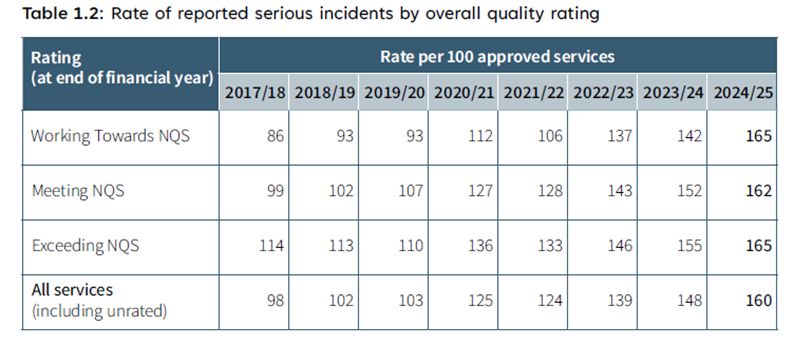
Source: Australian Children’s Education and Care Quality Authority. (2025). National Quality Framework Annual Performance Report, p. 23.
That doesn’t explain why overall rates of serious incidents appear to be going up—rather, that’s explained by growth in the number of children attending ECEC, their hours of attendance, and the size of centres. Indeed, ACECQA’s report suggests that it ‘may be more robust and meaningful’ to report incidents per 100 approved places ‘as it goes some way to accounting for relative service size’ (2025, p. 22). By this superior metric, the rate of serious incidents in long day care centres fell slightly last year.
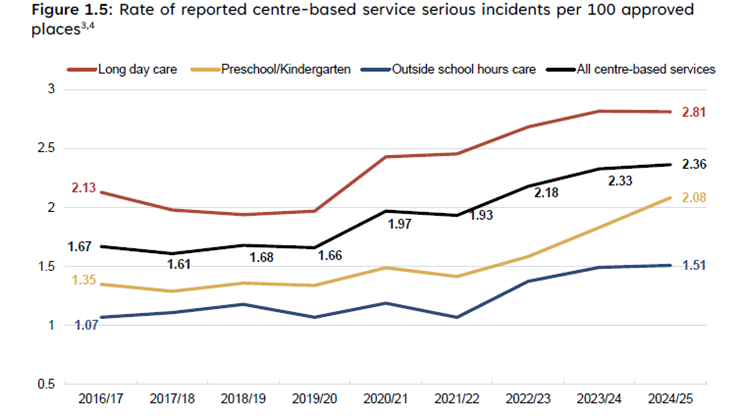
Source: Australian Children’s Education and Care Quality Authority. (2025). National Quality Framework Annual Performance Report, p. 22.
All parents know that very young children suffer accidents and illnesses. Children under the age of four have the highest attendance at hospital emergency departments of any age group. With very large numbers of very young children attending ECEC it is also the case that children have accidents and fall ill while in long day care.
While child safety must remain every centre’s absolute priority, new data published this year by ACECQA and ROGS found that 7.9% of serious incidents in centres were associated with a confirmed breach of the National Quality Framework (NQF) by the service, and 2.5% of incidents involving child injury were associated with an NQF breach. This suggests that while ECEC services provide generally very safe environments for children, services must continuously review and improve their supervision practices. The review of adequate supervision rules and guidance being led by Education Ministers will address this challenge.
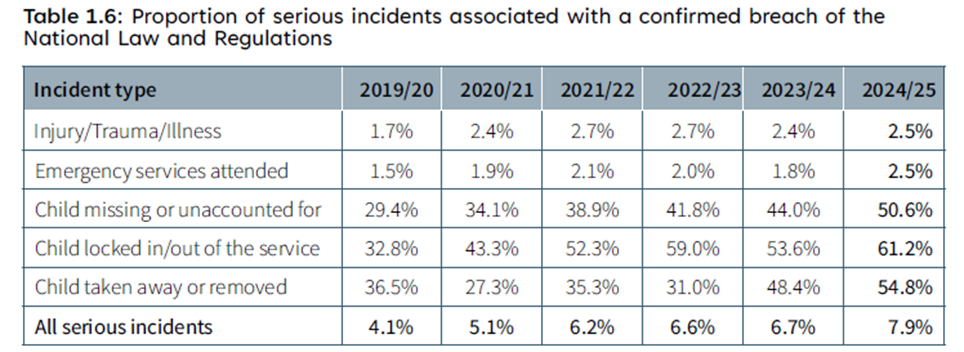
Source: Australian Children’s Education and Care Quality Authority. (2025). National Quality Framework Annual Performance Report, p. 28.
Regarding breaches of the NQF, the rate of confirmed breaches in long day care services rose from 254 per 100 services in 2024 to 279 per 100 services in 2025, with much of this growth explained by more children attending for more hours. Again, ACECQA cautions about the use of this data:
Not all confirmed breaches represent a risk to children’s health and safety, and the degree of risk varies according to the individual circumstances of the breach. It is also important to note that multiple confirmed breaches can be the result of a single event and the same service can be the subject of several confirmed breaches (2025, p. 24).
Indeed, while there were 40,000 ‘confirmed breaches’ of the NQF in 2025, these led to a total of 2,182 compliance actions being taken by regulators. And of these actions, 80% took the form of compliance notices or directions which typically direct a provider to comply with a provision of the NQF by a set date, with 20% made up of more serious directions and penalties.
The most powerful message from this year’s ROGS data is simply this: centres struggling to meet the NQF—those who are assessed as Working Towards—are almost five times more likely to have a breach than an Exceeding service: there were 503 confirmed breaches per 100 services for Working Towards compared to 117 for Exceeding services. Improving quality and safety go hand-in-hand, with investment in workforce capability and culture a key driver. Exceeding-rated services report more and are breached less, while their educators tend to be better paid, better trained and more experienced. Child safety starts and ends with centre quality.
What else does ROGS tell us about the state of Australia’s ECEC sector?
The Productivity Commission’s Report is an annual stocktake of the performance of Australia’s ECEC systems. It shows steady progress towards a universal early learning system in Australia, built on access, affordability, quality and inclusion. Following is an overview of some of the key ROGS findings:
- On child outcomes: children who do not attended ECEC are twice as likely to be developmentally vulnerable as those that do (table 3A.45).
- On supporting parents to work: people not in the labour force because of child care reasons fell 29% from 86,000 to 61,000 between 2021 and 2025 (table 3A.44).
- On workforce: more people commenced studying to be early childhood teachers or educators in 2023 than in any of the previous seven years (tables 3A.39 and 3A.40), while the share of long day care centres needing a staffing waiver fell from 17% in June 2023 to 11% in September 2025.
- On affordability: the median cost of a preschool program (after subsidies) in long day care fell from $4.58 p/hr in 2022 to $3.17 p/hr in 2024 (table 3A.24), while a family with an income of $175,000 with a child in long day care for three days (30 hours) spent 4.5% of their disposable income on childcare in 2024 (table 3A.23).
- On access: the proportion of three- and four-year-olds in a preschool program rose 2% in 2024 (table 3A.10), while the proportion of children aged birth to five years in a CCS-approved services rose from 49.8% (June 23) to 50.4% (June 24) to 50.9% (June 25) (table 3A.8).
- On inclusion: the proportion of children in early learning with a disability rose from 5.4% to 5.8% since 2021, while the proportion who were First Nations children rose from 4.3% to 7.4% (table 3A.15).
- On quality: the proportion of services Meeting or Exceeding the National Quality Standard rose from 86% to 91% since 2021 (table 3A.30), although the number of services assessed as Working Towards is still too high.
In all, the sector is making progress towards building a universal ECEC system that is high-quality, safe, inclusive, accessible and affordable—but more needs to be done. The immediate priority is implementing the child safety reforms agreed to by governments last year, while progressing the long list of recommendations in the Productivity Commission’s report on the pathway to a universal ECEC system.
References
Australian Children’s Education and Care Quality Authority (ACECQA). (2025). National Quality Framework Annual Performance Report. https://www.acecqa.gov.au/sites/default/files/2025-12/2025-NQF-Annual-Performance-Report.pdf
Productivity Commission. (2026). Report on Government Services 2026,PART B, SECTION 3: Early childhood education and care. Australian Government. https://www.pc.gov.au/ongoing/report-on-government-services/child-care-education-and-training/early-childhood-education-and-care/